

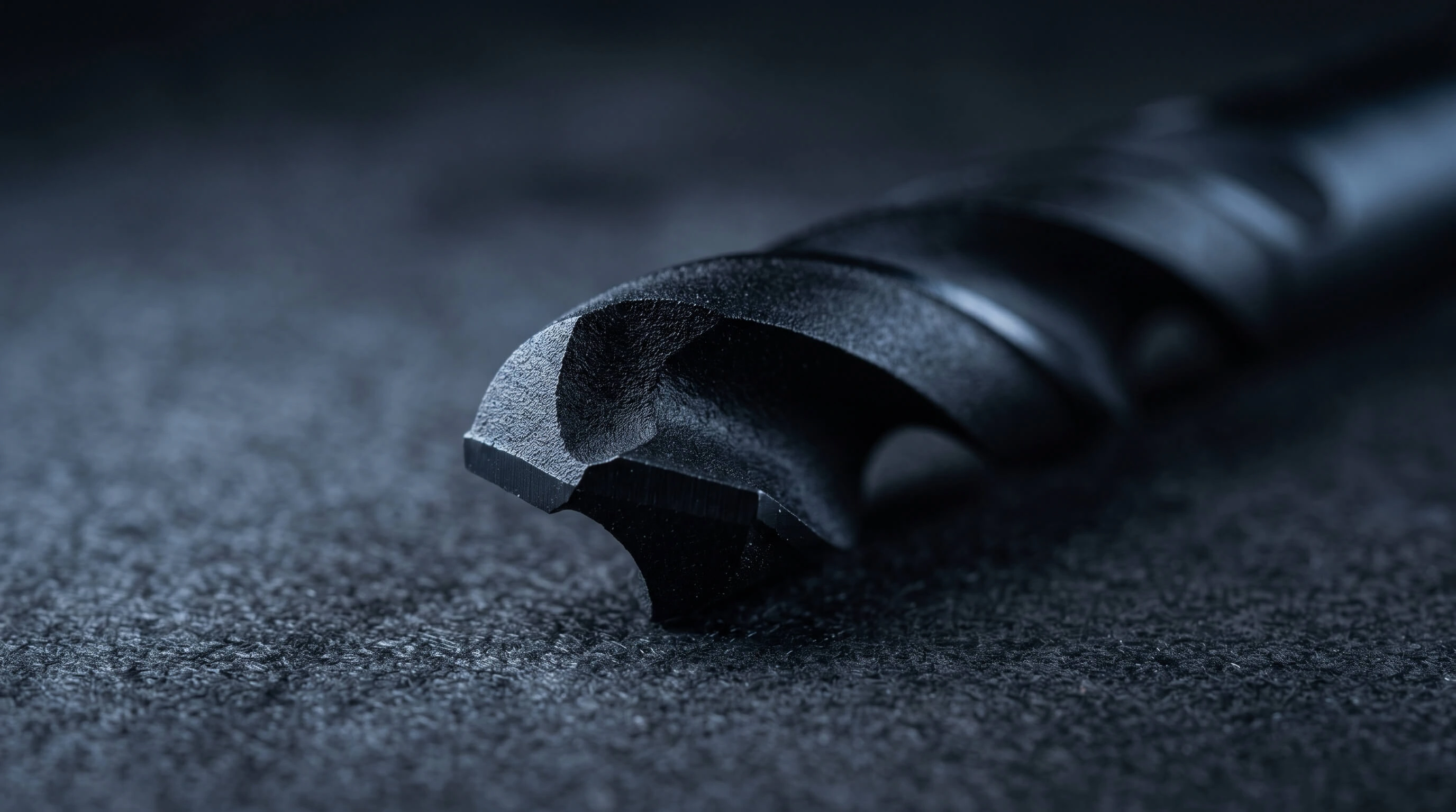
CVD (chemical vapour deposition) diamond coating is applied by growing a dense layer of diamond directly onto a finished carbide drill in a high-temperature reactor.
The diamond bonds to the carbide and forms a hard, wear-resistant barrier between the tool and the abrasive material it cuts, so the drill holds its cutting edge in CFRP, graphite and aluminium-silicon far longer than uncoated and conventional coated carbide. It is not the same as PCD, where a diamond tip is brazed onto a tool body; here the diamond is grown as a layer of coating.
What is CVD diamond coating?
CVD diamond coating is a layer of crystalline diamond grown onto a cutting tool through a very controlled, precise process, carbon is deposited and converted into a diamond structure on the tool’s surface. Exactaform’s Aero-CARB drills use this technology to create a highly wear-resistant layer, which can be controlled to the thickness the application needs. Because diamond is the hardest known material, even a thin layer dramatically improves the tool’s resistance to abrasive wear.
How is a diamond-coated drill different from PCD?
Both use diamond, but in different forms. A diamond-coated drill is a carbide tool with a diamond layer grown onto its surface. A PCD (polycrystalline diamond) drill uses diamond segments brazed onto a tool body.
Because the CVD process deposits diamond directly onto the finished cutting tool, there is no restriction on the shape or geometry it can coat, even complex drill forms. A PCD tool needs a more basic form, with its benefit coming from extremely long tool life and accuracy.
How is the coating applied to a carbide drill?
It starts with a finished carbide drill whose cutting edge and geometry have been prepared with a small allowance, the drill is made fractionally under size to accommodate the required coating thickness. The tool is then placed in a reactor where diamond is grown onto its surface through the chemical vapour deposition process. The aim throughout is to preserve the drill geometry designed to produce good hole quality, with the coating enabling it to hold that quality for longer.
How thick is the coating, and why does it matter?
The coating is typically around 8 microns. That thickness is a deliberate balance: thick enough to give a durable, wear-resistant barrier, but thin enough to preserve a sharp, accurate cutting edge. Too thick and the cutting edge can lose definition; too thin and it wears through too quickly.
Why does the coating stay bonded and not flake off?
Substrate choice is central. The carbide grades used for diamond-coated tools are specific ones, chosen to enable and guarantee coating adhesion. Diamond-coated drills are also used within a defined range of non-ferrous materials, where the in-process temperature stays below the point at which heat would start to affect the diamond structure. The coating’s whole job is to protect the underlying geometry against abrasive wear, so that bond is central to the design.
What does the coating do for the drill in service?
It slows abrasive wear, so the drill holds its cutting condition and produces good-quality holes across a longer run than uncoated carbide. That means fewer tool changes, more predictable hole quality and a more secure, stable process over a longer period in abrasive materials.
When is a diamond-coated drill the right choice?
Diamond-coated drills suit abrasive, non-ferrous materials, principally CFRP, graphite and aluminium-silicon alloys. They are a practical, cost-effective choice for lower to mid-volume production, for evaluating extra wear resistance, or where the tool has a very complex design. For hardened steels, titanium or high-heat work, carbide is often the better option; for established high-volume composite work, PCD’s longer life may justify the investment. Explore our diamond coated drills range.
Frequently Asked Questions
What is CVD diamond coating?
A crystalline diamond layer grown onto a cutting tool through chemical vapour deposition. It gives the tool an extremely hard, wear-resistant surface for machining abrasive materials.
Is a diamond-coated drill the same as PCD?
No. A diamond-coated drill is carbide with a diamond layer applied onto it; a PCD drill has a diamond tip brazed onto a tool body. PCD offers the longest life for high-volume work, while diamond-coated drills have a lower unit cost, are generally off-the-shelf and available across a large diameter range.
What materials suit a diamond-coated drill?
Abrasive, non-ferrous materials, principally CFRP, graphite and aluminium-silicon alloys. They are not for iron-based materials such as steels and irons, or for titanium alloys.
Does the coating make the drill last longer?
Yes, in abrasive materials. The diamond layer slows edge wear, so the drill holds hole quality across a longer run than uncoated carbide.
Can the coating be reapplied?
Diamond-coated carbide is not currently economical for Exactaform to recoat. This differs from PCD tooling, which can be reconditioned by relapping or retipping.