

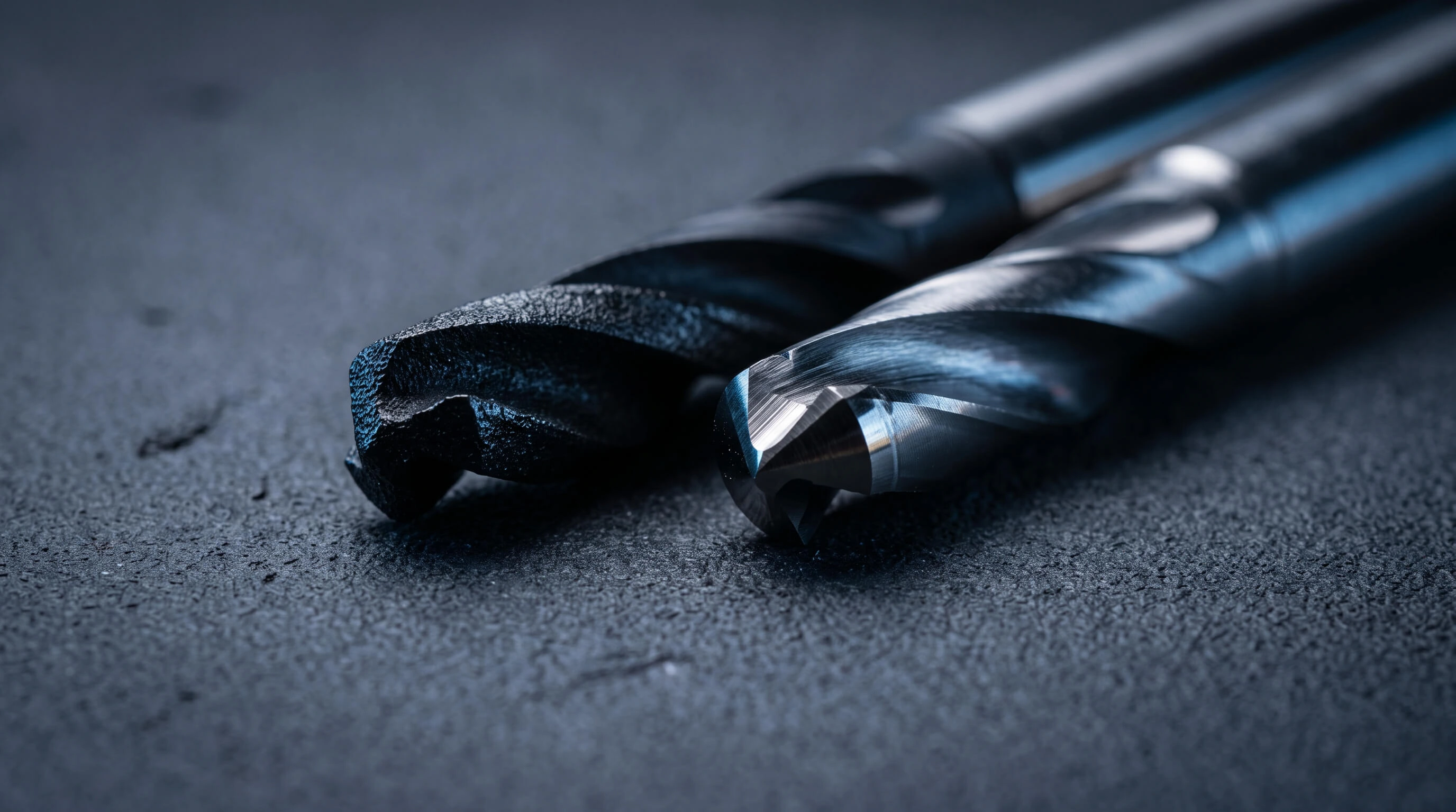
Diamond-coated drills suit low-to-mid volume composite drilling, where you need more wear resistance than carbide without committing to a bespoke tool. PCD-tipped drills offer the highest capability in higher-volume production, where their longer tool life and process stability can be measured.
The right choice should always come down to the most cost-effective solution for the job, taking into account the volume of work, the projected cost per hole, and availability meeting demand.
What is the difference between a diamond-coated and a PCD-tipped drill?
A diamond-coated drill is a carbide tool with a diamond layer applied to its surface. A PCD drill uses polycrystalline diamond tips brazed to the tool body. Both use diamond to resist the abrasion of composites, but the coated tool is a lower-cost, off-the-shelf option, while PCD is a higher-investment tool built for the longest life.
Tool life: how do they compare?
Both far outlast uncoated carbide in abrasive composites. PCD generally offers the longest tool life of the two, which is why it suits high-volume production. A diamond-coated drill closes much of the gap at a lower cost, which makes it well suited to lower and mid volumes.
Cost: purchase price vs cost per hole
Tooling made with advanced materials such as diamond-coated and PCD will always carry a higher initial outlay than more commonly used tooling materials, and that is worth expecting up front. But in production the number that matters is cost per hole, not the sticker price.
Cost per hole spreads the tool over everything it produces before it needs changing, and it takes in more than the tool itself. Machine time, the labour and downtime around each tool change, and any scrap or rework from holes that drift out of tolerance all sit inside that figure. A cheaper tool that wears quickly can end up costing more once those are counted, because it produces fewer good holes and interrupts the process more often.
Seen that way, the comparison changes. A diamond-coated drill carries a lower entry cost and is generally available off the shelf, which keeps cost per hole sensible at lower and mid volumes. PCD costs more to buy, but across a long, high-volume run its tool life can bring the cost per hole down further than a coated tool will, and it can be relapped and re-tipped rather than replaced outright. Availability matters too: the right tool is only the cheaper option if it is on hand when the job needs it.
Hole quality and finish
In composites, hole quality is decided at the cutting edge. Both diamond-coated and PCD drills hold a clean edge for far longer than uncoated carbide, purely through their resistance to abrasive wear, and that is what keeps quality stable across a run.
A sharp, stable edge shears the fibres cleanly rather than tearing them. That helps control delamination and fibre breakout, keeps burr formation down, and holds entry and exit condition consistent from the first hole to the last. As an uncoated edge wears, the cut degrades and those problems tend to appear together, so the value of a wear-resistant tool is not only longer life but a more predictable result across the batch. Where hole quality feeds into downstream assembly or bonding, that consistency is often as important as the tool life itself.
When to choose diamond-coated, and when to choose PCD
Choose diamond-coated for lower to mid volumes and where off-the-shelf availability matters. It gives a meaningful step up in wear resistance over carbide without the cost or lead time of a bespoke tool, it suits more complex geometries because the coating is grown onto the finished drill, and it is a practical way to prove the extra wear resistance on a job before committing further.
Choose PCD for established, high-volume production, where maximum tool life and long-term stability justify the investment. At that scale the longer life brings the cost per hole down, the process stays stable across long runs, and being able to relap and re-tip the tool adds value across its life. In practice the decision comes back to the material, the volume and the quality target, and the two tools often sit alongside each other in the same facility rather than competing.
Frequently Asked Questions
Is diamond-coated the same as PCD?
No. A diamond-coated drill is carbide with a diamond layer applied onto it; a PCD drill has a diamond tip brazed onto a tool body. PCD offers the longest life for high-volume work, while diamond-coated drills have a lower unit cost, are generally off-the-shelf and available across a large diameter range.
When is PCD worth the investment?
When you are running high-volume production, where longer tool life and stability outweigh the higher purchase price.
Can either be reconditioned?
PCD can be relapped and potentially retipped. Diamond-coated carbide is not currently economical to recoat.