


For US employers managing hand–arm vibration exposure, a practical question continues to arise: Are manual HAV calculations sufficient or does operational complexity now require automated monitoring?
In the United States, employers are expected to assess and control vibration-related workplace hazards under OSHA's broader duty to provide a safe workplace. OSHA does not currently prescribe specific hand-arm vibration EAV or ELV thresholds like 33 other countries around the world, including the UK and all of Europe. Instead, safety professionals typically estimate daily vibration exposure using recognised methods, such as ANSI/ASA S2.70, NIOSH, or ACGIH guidance, and use those results to determine whether additional controls are needed.
How that exposure is determined, through estimation or recorded data, directly affects the reliability of HAV program documentation.
Why Exposure Accuracy Matters
Hand-arm vibration exposure accumulates across:
- Multiple tools
- Variable trigger times
- Different materials
- Changing work patterns
Long-term vibration exposure is associated with vascular, neurological, and musculoskeletal symptoms, including those commonly referred to as Hand–Arm Vibration Syndrome (HAVS). If vibration exposure is underestimated, organisations may not have a clear understanding of the worker's exposure experience.
For this reason, accurate vibration exposure recording is central to a structured Hand-Arm Vibration Risk management program, not something to be taken lightly.
Manual HAV Calculations: How They Work
Manual HAV calculations typically involve:
- Manufacturer-declared vibration magnitudes
- Estimated trigger (usage) time
- Spreadsheet-based A(8) calculations
- Periodic review of risk assessments
This approach can meet expectations in lower-complexity environments, particularly where tool use is limited, tasks are predictable and trigger time is stable.
Manual, estimation-based calculation methods may be appropriate where operating conditions are simple and consistent. However, this reliability depends heavily on the accuracy of estimates.
Unfortunately, estimation-based methods are less accurate because they depend heavily on assumptions about tool use, exposure duration, operating conditions, and operator behaviors.
Limitations of Manual Calculations in Practice
In operational settings, several variables affect vibration exposure:
- Tool condition and maintenance
- Accessory type
- Operator grip and technique
- Surface material/Application
- Multi-tool usage within a shift
Manufacturer vibration emission values are measured under controlled conditions and may not reflect real-world use as the tools do not typically contact a human hand during the testing process.
Just as every worker is different, exposure varies significantly between operators and/or shifts; therefore, estimation-based systems can produce inconsistent or incomplete records.
From a documentation standpoint, this increases reliance on assumptions rather than actual recorded exposure data.
Automated Monitoring Systems: A Data-Led Alternative
Automated vibration monitoring systems are designed to capture exposure data during tool use, eliminating reliance on estimated trigger times.
A structured monitoring system includes:
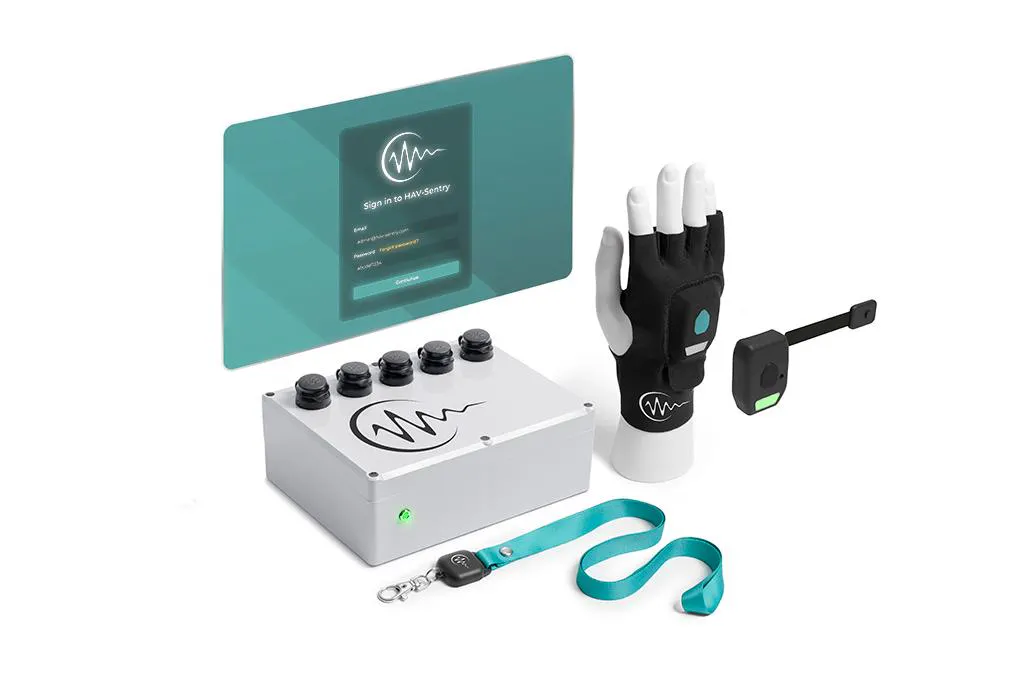
- A wearable vibration sensor
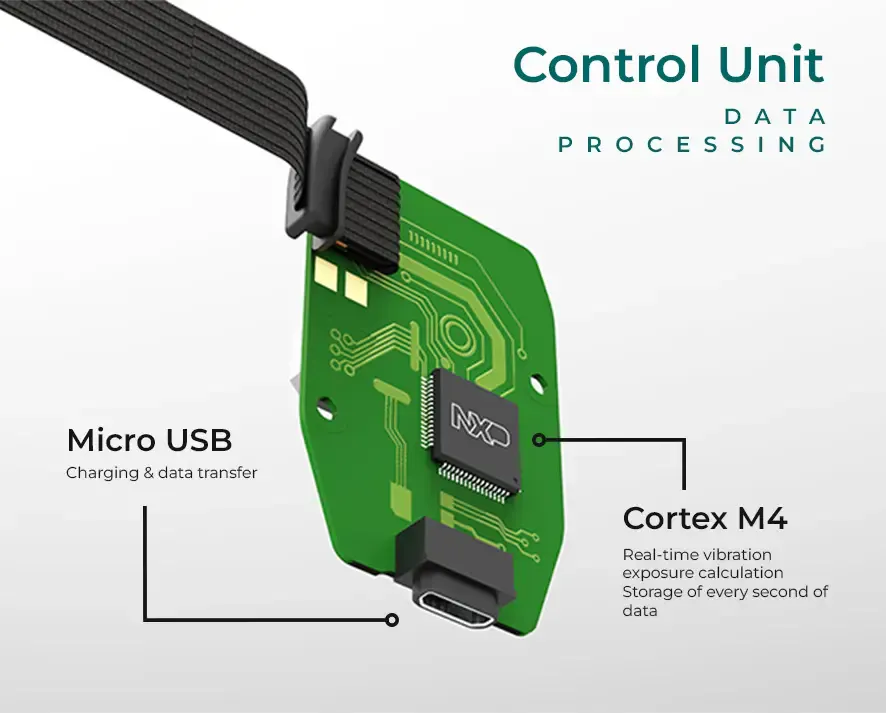
- A data capture unit
- Software supporting exposure calculation and review
- Centralised reporting across operators, tools, and shifts
Rather than reconstructing exposure retrospectively, exposure data is recorded as work is carried out.
This does not replace required management controls, but it does improve visibility into cumulative exposure.
In environments involving:
- Multiple tools
- Rotating shifts
- Mobile teams
- Variable trigger times
- Changing materials, applications, or work methods
Recorded exposure data can strengthen the quality, consistency, and defensibility of vibration assessments by eliminating reliance on assumed generic exposure values.
The real distinction here is between assumed/estimated documentation and accurate exposure evidence.
Under US Workplace Safety Expectations Regarding Vibration Exposure, Employers Should:
- Assess employee exposure to hand-arm and/or whole-body vibration hazards
- Identify tools, tasks, operating conditions, and trigger times that may contribute to vibration exposure
- Evaluate exposure using recognised methods, such as ANSI, ISO, ACGIH, or NIOSH-referenced approaches where applicable
- Compare exposure levels against relevant guidance values or recommended limits, noting that OSHA does not currently maintain a dedicated vibration exposure standard
- Reduce vibration risk through feasible engineering controls, administrative controls, tool selection, maintenance, task rotation, and training
- Provide medical evaluation or health surveillance where vibration-related symptoms or elevated risk indicators are identified
When conditions are simple, estimates may be sufficient. When work is variable, mobile, or multi-tool, accurately measured data provides a stronger basis for understanding actual vibration exposure; and then upon reassessment demonstrates that vibration risk has been evaluated and controlled using best practices as recognised by OSHA's Hierarchy of Controls.
HAV-Sentry's Perspective: From Estimation to Exposure Visibility
HAV Sentry is designed to support vibration exposure monitoring by capturing structured exposure data across operators, tools, and tasks.
It supports organisations by:
- Recording individualised worker vibration exposure data
- Providing visibility into cumulative exposure
- Supporting A(8) calculation and review
- Producing structured exposure reports for internal documentation
Monitoring does not eliminate vibration exposure, nor does it replace risk assessment or required control measures.
It provides real-world vibration exposure data that informs risk review and documentation processes.
Supporting Medical Surveillance Processes
Exposure records play an important role in medical surveillance planning.
Structured exposure data may support:
- Scheduling of surveillance in line with ANSI suggested EAV thresholds
- Review of exposure history during occupational health assessment
- Internal documentation per HAV Program
Clinical decisions remain the responsibility of occupational health professionals.
Vibration Monitoring supports documentation. It does not diagnose or treat conditions.
Practical Deployment in US Operational Environments
Automated systems are typically deployed as:
- Individual wearable monitoring units or
- Team-based monitoring kits
- Durable configurations for site-based operations
This enables exposure tracking across construction, utilities, rail maintenance, manufacturing, and advanced engineering settings.
The automated system must integrate into existing safety programs, not operate separately from them.
Which Approach Is Appropriate?
Manual HAV calculations may remain suitable where:
- Tool use is infrequent
- Exposure is predictable
- Operational complexity is low
However, where exposure is:
- Cumulative
- Variable
- Multi-tool
- Multi-operator
- Multi-task
Automated monitoring systems provide more consistent vibration exposure records.
This comparison reflects a broader shift in US occupational risk management, from assumption-based exposure tracking to more structured vibration exposure visibility.
A Measured Approach to Vibration Risk Management
For organisations operating in the United States, the choice between manual and automated vibration exposure assessment is not about technology replacing compliance.
It's about how exposure data is generated, recorded, and reviewed.
Vibration risk management is typically supported through recognised occupational safety practices, including OSHA hazard-control guidance, NIOSH recommendations, ACGIH guidance, and ANSI/ASA standards. OSHA guidance also emphasises controls such as limiting tool-use duration, providing breaks, training employees on vibration hazards, and reducing exposure through work practices and equipment selection.
HAV Sentry is a vibration exposure monitoring system designed to support US safety programs in these best safety practices with structured vibration exposure recording by worker, by tool, and by process. This automated monitoring system does not replace management controls or professional judgment. Rather, it eliminates reliance on assumed exposure values and provides accurate visibility of vibration exposure across complex operations.